


“I’ve heard I can spend up to nine months a year at my French home without moving to France permanently.“
It may sound too good to be true, but in many cases the answer is yes.
Most people know about the Schengen rule that limits visa-free stays to 90 days in any rolling 180-day period. Fewer people realise that France also offers a temporary long-stay visa which, when used in the right circumstances, can extend that stay considerably.
The key is understanding that these are two separate sets of rules. Once you see how they fit together, the nine-month stay becomes much easier to understand.
Understanding the 90-day Schengen rule
If you’re from a country whose citizens can visit the Schengen Area without a visa, you can normally stay for up to 90 days in any rolling 180-day period.
For many people, that’s enough.
For others—particularly second-home owners and retirees—it often isn’t.
That’s where the VLS-T comes in.
How the VLS-T works
A VLS-T allows you to stay in France for between four and six months.
The important point isn’t simply that it lets you stay longer.
It’s how it lets you stay longer.
While your VLS-T is valid, you’re in France under the authority of a French national long-stay visa, not under the normal Schengen short-stay rules.
As a general rule, the time you spend in France during a valid VLS-T doesn’t count towards your normal 90-day Schengen visa-free allowance.
There is one important limitation.
A VLS-T only covers your stay in France.
If you leave France during that period to visit another Schengen country—even for a day trip to San Sebastián or a weekend in Italy—those days are no longer covered by your French visa. Instead, they count towards your normal 90-day Schengen allowance.
For people who spend virtually all of their VLS-T in France, this isn’t usually a problem. It’s simply something worth knowing if you’re planning to travel around Europe.
How a VLS-T can lead to a stay of up to nine months
Imagine you’re granted a six-month VLS-T running from 1 April until 30 September.
For those six months, you’re staying in France on your long-stay visa.
When the visa expires, you don’t necessarily have to leave.
Provided you still meet the normal conditions for visa-free entry, you can usually remain in France under the ordinary Schengen rules for up to a further 90 days.
Your stay could therefore look like this:
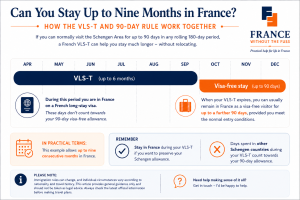
In practical terms, that’s up to nine consecutive months in France.
A word of caution : immigration law is rarely straightforward. The example above illustrates how the rules commonly work in practice, but individual circumstances—including your nationality, previous travel and future plans—can affect how they apply.
.
Why it isn’t always nine months
Because there isn’t a guaranteed nine-month entitlement.
Some VLS-T visas are issued for four or five months rather than six.
And when your visa expires, you don’t automatically receive a fresh 90-day allowance. The legal rule always remains 90 days in any rolling 180-day period.
For many people who have spent the previous six months in France on a VLS-T, the practical outcome is that they can then remain for up to a further 90 days as visa-free visitors.
.
Do you have to leave France when a VLS-T expires?
In normal circumstances, no.
The common understanding—and the way the rules are generally applied—is that you don’t need to cross the border and re-enter France simply because your VLS-T has expired.
That said, official guidance doesn’t appear to spell this point out explicitly. For that reason, it’s sensible to keep evidence that your stay began under a valid VLS-T, including your passport, visa and any travel documents.
VLS-T vs VLS-TS: What’s the difference?
Be warned, there are two French long stay visas with very similar names, the VLS-T and the VLS-TS. They’re very different – don’t get caught out!
| VLS-T | VLS-TS |
| Temporary long-stay visa | Long-stay visa equivalent to a residence permit |
| Valid for four to six months | Usually valid for up to one year |
| Intended for extended temporary stays | Intended for people relocating to France |
Is a VLS-T right for you?
A VLS-T isn’t designed for people who are moving permanently to France.
It’s intended for visitors who want to spend an extended period in France before returning home.
If you own a holiday home, are planning a long sabbatical or simply want to enjoy several months of French life without relocating permanently, it’s an option that’s well worth exploring.
The bottom line
A VLS-T doesn’t magically give you nine months in France.
What it does do is change the legal basis on which you’re staying. For many visitors, that means they can combine a temporary long-stay visa with the normal visa-free allowance. That way, they can spend considerably longer in France than the Schengen 90-day rule would otherwise permit.
Still not sure what’s best for you?
Every situation is different. The best option depends on your nationality, how long you’d like to stay, and whether you’re planning an extended visit or a permanent move.
If you’re trying to make sense of the French administrative system and would like someone to explain the process in plain English, I’d be happy to help.