

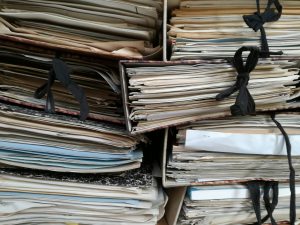
There you are, standing at the desk, rummaging through your dossier while a small queue forms behind you. You know the document they’re asking for is in the folder you submitted last month. It’s just that it’s refusing to surface the moment you need to produce it – again.
It’s tempting to take this personally, or to read it as inefficiency. It isn’t. It’s a pattern, and once you understand the logic behind it, the paperwork stops feeling quite so absurd, even if it doesn’t get any faster. (Ask anyone who’s been through the préfecture appointment process — it’s the same logic, just with higher stakes.)
What a “dossier” actually is
In everyday English, a “file” is just a place you keep your documents. In French administrative life, the dossier is closer to the thing itself: nothing really exists administratively until it’s on paper, signed or stamped, and sitting in the right file. Your situation isn’t what you say it is — it’s what your dossier says it is. (Napoleon is said to have been obsessed with paper archives. Who knows, perhaps that’s why France still loves a dossier ; )
That principle explains why you can be asked for the same piece of information again and again, by different offices or even the same office at a different stage. Each dossier is its own self-contained proof — the system trusts the paper trail, not your word, and not even necessarily what another office already has on file.
Why photocopies and stamps matter so much
This is the part that trips people up most. Handing over an original document proves that something happened — you were born, you got married, you signed a lease. But a stamped photocopy proves something slightly different: that you presented that proof to this office, on this date. It’s not redundancy for its own sake. Each stamp is a small, separate piece of evidence that a specific administrative step took place.
Once you see it that way, the endless copies stop looking like busywork and start looking like what they are: the system building its own paper trail of your paper trail.
How to avoid a dodgy dossier
The practical response to all this isn’t to fight the logic — it’s to out-prepare it. Long-term residents tend to develop a few quiet habits: keeping a small home dossier of the documents they’re asked for most often, making extra copies before they’re asked for them, and never assuming that “they already have that” will save them a trip back with the original.
It feels like overkill until the day it saves you a second appointment.
Patience as a survival skill
The other shift is emotional rather than practical. Waiting, being asked to come back, being told a piece of paper needs to be dated within the last three months — none of this means something has gone wrong. It’s the system working as designed, just slowly. Expecting friction, rather than being surprised by it each time, makes an enormous difference to how the whole process feels.
The bottom line
It really isn’t about mistrust or inefficiency for its own sake. It’s a different administrative culture, one built on paper proof rather than verbal assurance. It takes some getting used to, but it’s learnable, and once you know the logic, a lot of the frustration falls away.
This kind of cultural friction is often invisible until you’ve lived through it — and it’s exactly the sort of thing I help people navigate. Whether you’re planning your move or trying to untangle a particular administrative issue, I offer practical, bilingual support to help you handle it without the guesswork.